
More info
Lysimachia parvifolia ‘Red’, long known in the aquarium hobby under the provisional name Samolus parviflorus ‘Red’, is an unusual and still rare aquatic plant. It was originally discovered growing fully submerged in a river within the limestone regions of Guangxi Province, southern China, and for several years circulated only privately among aquarists.
Closer botanical examination has shown that the plant does not belong to the genus Samolus, but is in fact Lysimachia parvifolia, a loosestrife species native to southern and south-eastern China. In nature, it inhabits wet environments such as stream banks, irrigation channels, ditches, and rice paddies.
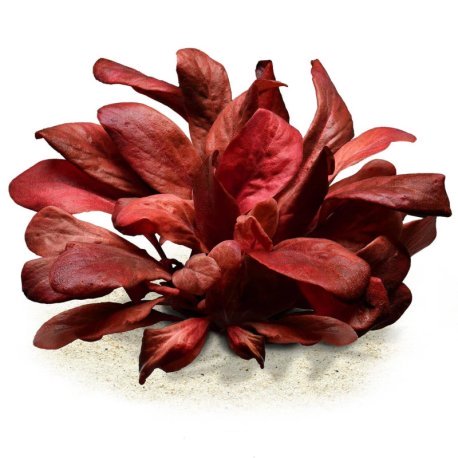
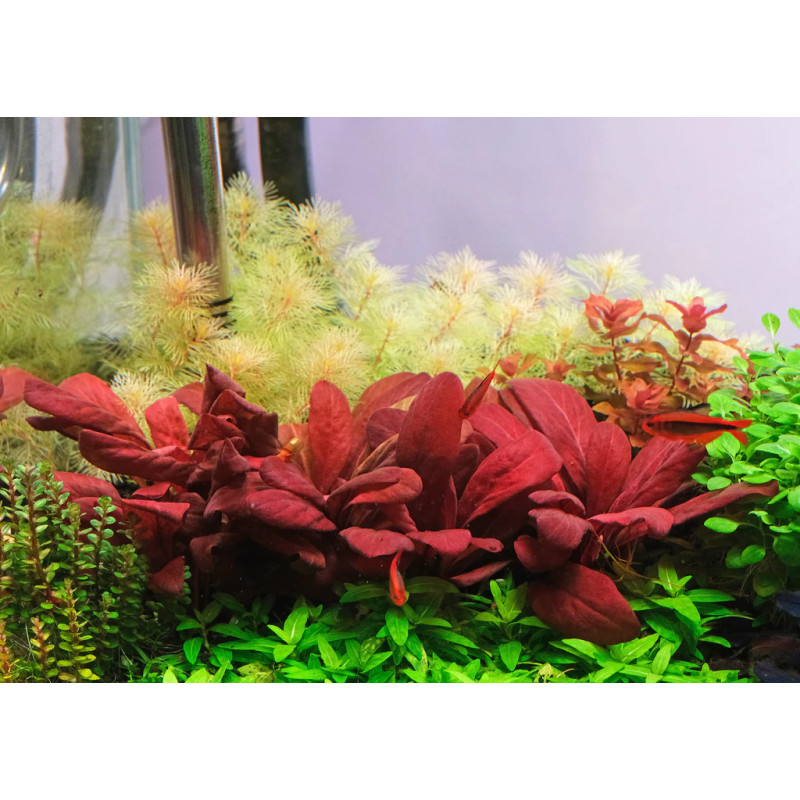
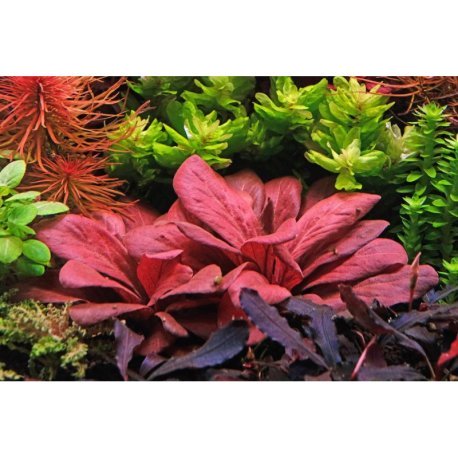
When grown submerged, the plant develops a broad, rosette-like growth form, typically 10–20 cm wide, producing multiple shoots. Under lower light conditions, elongated shoots may appear. With strong lighting, the leaves display intense red to dark red coloration, while weaker lighting results in more orange-red tones.
The emersed form is completely different in appearance. The plant produces flowering shoots 30–50 cm tall, along with numerous long, runner-like, flagelliform side shoots. Emersed leaves are alternate, narrowly elliptical to spatulate, green to slightly reddish, and much smaller (approximately 1–4.5 cm long) than the submerged leaves — the origin of the name parvifolia (“small-leaved”). The stem is usually reddish, and small white, almost bell-shaped flowers appear on upright racemose inflorescences.
Although Lysimachia parvifolia ‘Red’ is easy to grow, its most intense red colours develop under strong lighting, ideally with PAR values of at least 100 µmol. CO₂ injection is not strictly necessary, but together with a nutrient-rich substrate it promotes more vigorous and lush growth. Exact temperature requirements are unknown, but given its subtropical origin — with hot, humid summers and mild, cooler winters — the plant tolerates a wide temperature range.
Propagation is achieved by dividing the leaf rosette into individual shoots. Additionally, roots and adventitious shoots may form from detached leaves floating in the water, similar to propagation observed in Hygrophila species.
Currently still a rarity, Lysimachia parvifolia ‘Red’ is expected to become more widespread due to its robustness and ease of cultivation. In aquariums, it forms a striking red accent in the foreground to midground. In emersed cultivation, while less visually dramatic, its creeping shoots and delicate white flowers make it an interesting choice for paludariums and wabi-kusa setups.
Key Cultivation Parameters
| Light | Moderate to very high (≥ 100 µmol PAR for best colour) |
| Temperature | Wide tolerance (subtropical origin) |
| CO₂ | Optional, beneficial |
| Substrate | Nutrient-rich recommended |
| Growth rate | Moderate |
| Placement | Foreground to midground |
| Propagation | Rosette division, detached leaves |
Illustrative photo. | Representative image only.


